 Sarasota Siding
 Two Different Materials, Two Different Bets
When a homeowner in Sarasota starts pricing a siding replacement, two materials tend to show up on every contractor's quote sheet: fiber cement and engineered wood. Both are marketed as upgrades over vinyl. Both claim to solve the rot and pest problems that plague old-fashioned solid wood siding. And both can look genuinely good on a finished home. But they are not the same product wearing different labels — they're built from different raw materials, and those materials behave very differently once they're bolted to a house fifteen miles from the Gulf of Mexico.
We install James Hardie fiber cement siding exclusively. We don't install LP SmartSide or any other engineered wood product, and we think homeowners deserve a straight explanation of why — not a sales pitch, not a scare tactic, just an honest look at what each material is, what it does well, and where it runs into trouble in a Sarasota County climate that includes hurricane-force wind events, wind-driven rain, salt-laden air, and some of the most relentless UV exposure in the country.
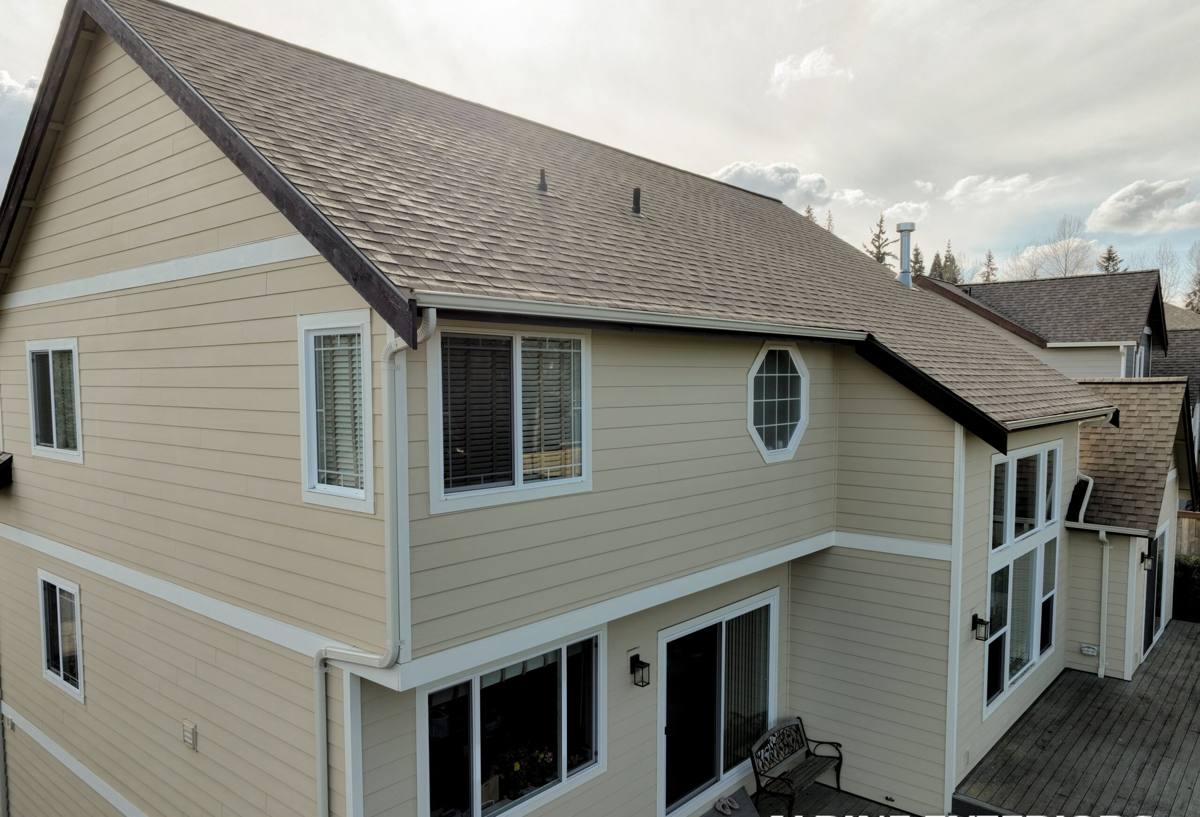
What Engineered Wood Siding Gets Right
It's worth saying plainly: engineered wood siding, the category LP SmartSide represents, is a legitimate building product and a real step up from raw dimensional lumber siding. It's manufactured from wood strands bonded with resin under heat and pressure, then treated with a zinc borate formulation intended to resist fungal decay and termites. That treatment is baked into the substrate, not just applied to the surface, which is a meaningful improvement over untreated wood.
It also has practical advantages that make it attractive to builders and homeowners on a budget:
- Lower material cost per square foot than fiber cement in most markets
- Lighter weight, which can mean faster installation and lower labor time
- Easier to cut and fasten with standard woodworking tools
- A wood grain texture that reads as more traditional to some homeowners
For a builder trying to hit a price point, or for a climate with mild humidity and limited storm exposure, engineered wood can be a defensible choice. The problem isn't that the product is poorly made. The problem is what happens when that product spends decades on a home a few miles from saltwater, under a Florida sun, in a county that sees tropical storms and hurricanes on a recurring basis.
Where Wood-Based Products Struggle on the Gulf Coast
Moisture Is the Enemy, and Sarasota Has a Lot of It
Engineered wood siding is still, at its core, wood. Wood strands and resin can resist moisture better than solid lumber, but the underlying chemistry hasn't changed: cellulose absorbs water, and repeated wetting and drying cycles stress the bond between strands over time. Sarasota's humidity rarely drops below uncomfortable, and the rainy season brings sustained wind-driven rain that gets pushed sideways into wall assemblies, not just straight down onto a roof. Any wood-based product depends heavily on perfect caulking, perfect flashing, and prompt repair of any breach in the factory coating to keep water out of the edges and fastener penetrations, which are the most vulnerable points on any siding panel.
Cut Edges and Field Joints
Every engineered wood panel arrives from the factory with a treated, sealed surface. The moment an installer cuts it to fit a corner, a window, or a utility penetration, that cut edge is exposed substrate — untreated, unsealed, and directly exposed to the elements unless it's field-sealed correctly and maintained. On a home with a lot of trim details, dormers, and window openings — common on Sarasota architecture — that's a lot of cut edges. Missed or degraded edge sealant is one of the most common ways moisture gets into an engineered wood wall system.
Salt Air and UV Load
Sarasota County's proximity to the Gulf means airborne salt is a constant, low-grade stressor on every exterior surface, accelerating the breakdown of coatings and adhesives. Combine that with year-round, high-intensity UV exposure, and any product whose long-term performance depends on an intact factory finish is working against tougher odds here than it would in a drier, less coastal climate. When a coating on a wood-based product degrades faster than expected, the underlying material is more exposed to exactly the kind of moisture cycling described above.
Fiber Cement: What It's Actually Made Of, and Why That Matters
Fiber cement siding, the category James Hardie pioneered and still leads, is a fundamentally different material. It's manufactured from Portland cement, sand, and cellulose fibers, cured into a dense, stable board. There's no wood strand core to swell, no resin bond to break down under repeated wetting, and the material itself is non-combustible — a genuinely different risk profile than any wood-based product, engineered or not.
That composition gives fiber cement a few structural advantages that matter specifically in a hurricane-prone coastal county:
- Dimensional stability across humidity swings — it doesn't expand and contract the way wood-based products can
- Resistance to termites and wood-boring insects as a function of the material itself, not a chemical treatment that can wear off
- Non-combustible composition, which some insurers factor into coverage and premiums
- A track record of decades of field performance in coastal and hurricane-exposed markets, including Florida
Side-by-Side: Fiber Cement vs. Engineered Wood
| Factor | James Hardie Fiber Cement | Engineered Wood (LP SmartSide) |
|---|---|---|
| Core material | Cement, sand, cellulose fiber | Wood strands bonded with resin |
| Combustibility | Non-combustible | Combustible (wood-based) |
| Moisture behavior | Dimensionally stable, resists swelling | Can swell/degrade with sustained moisture exposure |
| Pest resistance | Inherent to the material | Relies on chemical treatment (zinc borate) |
| Cut-edge exposure risk | Lower moisture sensitivity at cuts | Higher — cut edges need diligent field sealing |
| Factory finish option | ColorPlus baked-on finish, long-term color warranty | Factory primed or pre-finished, shorter finish warranty typical |
| Upfront material cost | Higher | Lower |
| Long-term maintenance burden | Lower when installed to spec | Higher — coating and caulk inspection is ongoing |
Installation Sensitivity: The Trade-off Nobody Puts on the Brochure
Every siding product, fiber cement included, performs only as well as its installation. Fiber cement has its own rules: proper fastener placement, correct clearance from grade and roof lines, factory-specified joint treatment, and painted or capped cut edges where the factory finish is disturbed. Get those details wrong and even the best material underperforms.
The difference is what happens when a detail gets missed. On fiber cement, an installation error is more likely to show up as a cosmetic issue — a visible seam, a caulk line that needs touch-up — because the substrate itself isn't the thing absorbing water. On engineered wood, an installation error at a cut edge or fastener penetration puts water directly into contact with a wood-based substrate, and the consequences compound the longer they go unnoticed. That gap in forgiveness is a big part of why we standardized on one product: we'd rather build in a margin for the small mistakes every real-world installation makes than depend on flawless execution over twenty years to keep a wall assembly dry.
Warranty Structure: Read What's Actually Covered
Warranty length gets quoted a lot in siding sales conversations, but the structure matters more than the number. A useful warranty should be transferable to a future homeowner (siding often outlasts ownership), should cover the factory finish separately from the substrate, and shouldn't carry so many installation-dependent exclusions that a claim becomes a negotiation. James Hardie's ColorPlus finish warranty and product warranty are two of the reasons we standardized on the brand — the coverage structure matches how long we expect the material to actually perform on a Gulf Coast home, not just how long it's expected to survive in a milder climate.
Why We Standardized on James Hardie for Every Home We Side
We made a deliberate decision years ago to install one fiber cement system rather than offer a menu of materials at different price points. Here's what that standard requires on every job:
- James Hardie's HZ5 climate-engineered product line, formulated for high-humidity, high-moisture regions like ours
- ColorPlus factory-applied finish, which reduces on-site painting and the long-term maintenance that comes with field-applied paint
- Manufacturer-specified fastening, clearance, and joint treatment on every install — not shortcuts to save labor hours
- Cut edges primed or capped per factory guidance before they're exposed to weather
- A material warranty structure that transfers to future owners
Choosing one product line means we know it cold — every detail, every failure point, every correct fix — instead of splitting our expertise across multiple systems with different installation rules and different tolerances for coastal conditions.
What This Means for Your Sarasota Home
If your current siding is engineered wood and it's holding up fine, that's genuinely good news — not every wood-based install fails, and a well-maintained system can perform for years. But when it's time to replace siding on a home in Sarasota County, the decision isn't just about upfront cost. It's about which material is engineered to shrug off the specific combination of hurricane-force wind, wind-driven rain, salt air, and relentless UV that this stretch of Gulf Coast delivers every single year, with the least ongoing maintenance and the fewest points where a small installation miss turns into a big repair bill down the road. That's the bet we made when we standardized on James Hardie, and it's the same reasoning we'll walk through with you, house by house, detail by detail.
If you're weighing a siding replacement and want a straight answer about what's actually on your walls now and what we'd recommend instead, we're happy to take a look. Reach out for a free, no-pressure estimate — no obligation, just an honest assessment.