 Sarasota Siding
 Siding on a Barrier Island Is a Different Job
Siesta Key sits out on a barrier island, separated from the Sarasota mainland by the Intracoastal Waterway, with the Gulf of Mexico on one side and bay waters on the other. That position is what makes the island famous for its beaches, but it's also what makes exterior materials work harder here than almost anywhere else in Sarasota County. Homes on or near the Key deal with salt-laden air on a near-constant basis, direct Gulf-front sun exposure with little tree canopy in many areas, and wind loads that spike hard during tropical systems moving in off open water. Siding that would hold up fine ten miles inland can fail early out here.
We work throughout Sarasota County, and the barrier island communities — Siesta Key included — get a different approach from us than a mainland subdivision would. The material selection, the fastening details, and the flashing choices all shift when a house is this close to open saltwater.
What the Climate Actually Does to a House Here
Salt Air and Corrosion
Airborne salt doesn't just affect boats and railings. It settles on siding, trim, and fasteners day after day, and over years it accelerates corrosion in anything not built to resist it and degrades coatings that aren't formulated for a marine-adjacent environment. Vinyl siding can look chalky and faded well ahead of schedule in this kind of exposure. Cheaper fastener hardware rusts and stains the face of the siding it's holding up.
Wind-Driven Rain and Hurricane Exposure
Siesta Key's exposure to the Gulf means wind-driven rain events aren't rare occurrences — they're a normal part of the weather cycle, and they intensify sharply during named storms. Wind-driven rain doesn't fall straight down; it drives sideways and upward under laps, around penetrations, and into any gap in the water management plane. A siding system is only as good as the flashing, house wrap, and fastening behind it — the visible material is the last line of defense, not the whole system.
Year-Round UV Load
Florida sun is intense everywhere in the state, but oceanfront and near-coastal properties often see less natural shading than mainland lots, meaning full sun exposure on more sides of the house for more hours of the day. UV breaks down pigments and resins in lower-grade coatings, which is why paint-grade wood and poorly finished composite products tend to chalk, fade, and need repainting on a shorter cycle out here than they would a few miles inland.
Humidity and Moisture Cycling
Between the bay side and the Gulf side, humidity stays high most of the year. Materials that absorb moisture swell; when they dry out they shrink. That expansion-contraction cycle, repeated for years, is what drives paint failure, joint gaps, and eventually rot in wood-based products that aren't fully sealed on every cut edge and fastener penetration.
Why We Standardized on James Hardie Fiber Cement
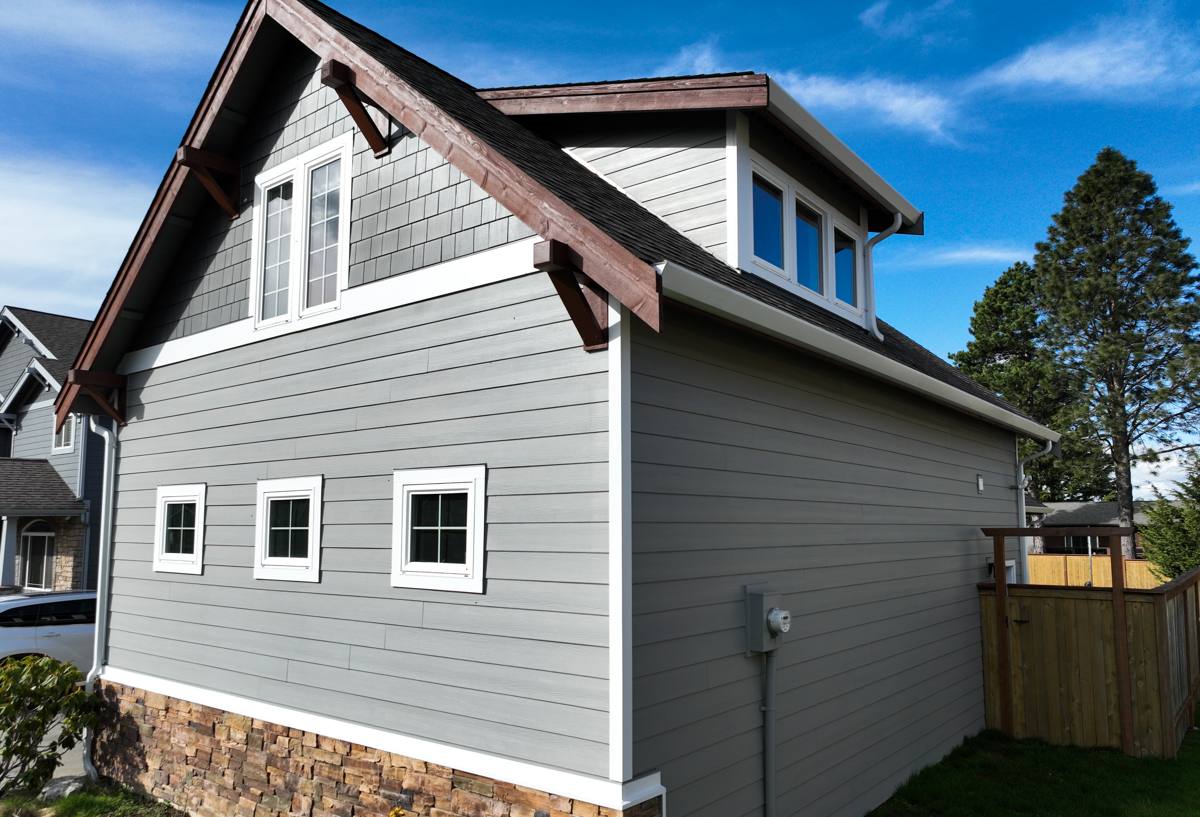
We install James Hardie fiber cement siding exclusively. We don't install vinyl, LP SmartSide, Cemplank, Allura, or primed wood species like spruce or cedar, and that's a deliberate standard, not a lack of options. Fiber cement is cement, sand, and cellulose fiber — it doesn't have the moisture-absorption problems of wood-based composites, and it doesn't have the heat-softening and impact-cracking issues that come with vinyl in high-UV, high-wind coastal exposure.
Hardie's ColorPlus factory-applied finish is baked on in a controlled environment and backed by its own finish warranty, which matters directly in a salt-air environment where field-applied paint tends to break down faster than it would inland. For homes near open water, Hardie also builds HZ10 product specifically engineered for high-humidity, high-moisture-cycling climates like ours — it's not a marketing label, it's a different formulation for a different climate zone.
What We Won't Install, and Why
- Vinyl siding: can deform in high heat and sustained direct sun, and seams and panels are vulnerable in sustained high wind events common to barrier-island exposure.
- LP SmartSide and similar wood-strand composites: engineered wood products depend on intact factory sealing at every cut and fastener; on a job with this much salt and moisture cycling, any breach in that seal shortens the product's service life.
- Cemplank and Allura fiber cement: both are legitimate fiber cement products, but we've standardized on one manufacturer, one finish system, and one warranty structure so every job we do is consistent and every warranty claim goes through the same process.
- Primed spruce or cedar: natural wood siding needs the most maintenance of any option here — repainting, caulking, and moisture monitoring on a tight cycle — and coastal humidity works against wood from day one.
How We Approach a Siesta Key Job
Inspection and Assessment
We start by looking at what the current siding and the substrate behind it are actually doing — where moisture has gotten in, where fasteners have failed, where flashing is missing or was never installed correctly. On an island property, we pay particular attention to any side of the house facing open water or prevailing wind, since that's typically where wear shows up first.
Water Management First
Before a single piece of siding goes up, the house wrap, flashing at windows and doors, and any penetrations (vents, hose bibs, light fixtures) get addressed. This is the part of the job that's invisible once it's finished, and it's the part that determines whether the siding lasts twenty years or fails in five.
Installation to Manufacturer Spec
Hardie's warranty depends on installation following the manufacturer's specifications — proper fastener type and spacing, correct clearances at grade and roofline, and correct joint treatment. We install to that spec on every job, which is also what keeps the warranty valid if you ever need it.
Fastener and Hardware Selection
In a salt-air environment, corrosion-resistant fasteners aren't optional upgrades — they're part of doing the job right the first time. Standard hardware that's fine forty miles inland can start showing rust streaks on a Gulf-facing wall within a few years.
Beyond Siding: Roofing, Windows, and Decks
Siding rarely fails in isolation on a coastal property — roofing, windows, and decking all face the same salt air, UV, and wind exposure, and problems in one system often show up as damage in another. A roof leak at a poorly flashed penetration can wick moisture sideways into wall assemblies. Aging window seals let wind-driven rain track down behind siding and trim. We handle all four exterior systems, which means when we're on-site for one job we can flag issues in the others before they become expensive.
Cost Factors for a Siesta Key Siding Project
| Factor | Why It Matters Here |
|---|---|
| Home size and complexity | More corners, dormers, and rooflines mean more flashing and trim detail, which adds labor time |
| Substrate condition | Water-damaged sheathing found during tear-off needs to be replaced before new siding goes on |
| Product line and profile | HZ10 formulations and specific plank profiles (lap, shingle-style) vary in material cost |
| Access and staging | Barrier-island lots, seawalls, and limited street parking can affect equipment staging and timeline |
| Fastener and flashing upgrades | Corrosion-resistant hardware and enhanced flashing details add cost but extend service life |
We give a firm number after an on-site look at the specific house — anything else is a guess, and coastal jobs have too much variation from property to property for a broad estimate to be useful.
What to Ask Before Hiring Anyone for Coastal Exterior Work
- Do you carry current Florida contractor licensing and insurance, and can you provide proof?
- Have you worked on barrier-island or near-coastal properties before, and can you describe how that changed your approach?
- What fastener and flashing details do you use specifically because of salt air and wind exposure?
- What does the manufacturer's warranty actually cover, and does your installation method keep that warranty valid?
- Will you put the scope of work, materials, and timeline in writing before starting?
Maintenance Once the New Siding Is Up
Fiber cement is low-maintenance compared to the alternatives, but "low" isn't "none," especially this close to the water. A periodic rinse to clear salt residue off the surface, a visual check after major storms for any displaced trim or caulk gaps, and prompt attention to any landscaping or irrigation spraying directly onto the siding will all extend the life of the finish. None of this is heavy lifting — it's the kind of upkeep that takes an afternoon a couple times a year.
A Local Crew Matters Here
Barrier-island work isn't the same as a standard mainland install, and a crew that does most of its work inland can miss the details that matter on Siesta Key — the fastener grade, the flashing sequence, the product line suited to direct Gulf exposure. We work across Sarasota County and know what this specific stretch of coastline does to a house over time, which shapes every material and installation decision we make out here.
If you're dealing with aging or storm-damaged siding on Siesta Key, or planning ahead of the next hurricane season, we'd be glad to take a look and give you a straightforward, no-pressure estimate.